Raw Materials for a Sustainable Future
The ESM Foundation, founded in 1951, is a Swiss non-profit organization dedicated to supporting research and development activities in the field of Rare and Critical Elements, with a focus on their industrial applications.
The ESM Foundation (Entwicklungsfonds Seltene Metalle) is a Swiss non-profit organization founded in 1951. We are dedicated to supporting research and development activities in the field of rare and critical raw materials, with a focus on their industrial applications.

- EU Court of Auditors warns of persistent dependence on critical raw materials
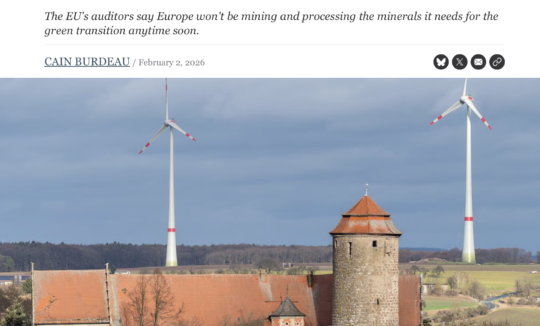 An article by Courthouse News Service reports on a new analysis by the European Court of Auditors, which concludes that the EU will remain heavily dependent on imports of critical raw materials for the foreseeable future. The report cites long permitting procedures for mining projects, a limited number of processing facilities within the EU, and… Read More
 - Urban Mining, Cooperation with the EU, Niche Strategies: Interview with Alessa Hool
 It is unrealistic to expect Switzerland to become self-sufficient. Instead, it should focus on ‘smart dependence’. In the last part of the series, Swiss Academy of Engineering Sciences (SATW) expert Alessa Hool explains the role that recycling, European cooperation and Swiss innovation can play, and where urgent improvements are needed. She highlights the potential of… Read More
 - IRTC White Paper published
 The project IRTC, coordinated by ESM, just released its recent white paper: “Global Assessments and Strategies for Critical and Strategic Raw Materials: The State of Play in 2025.” This report presents findings from the latest IRTC discussions, highlighting the critical role of raw materials in shaping economic, climate, industrial, and security policies. As nations increasingly… Read More

Our Vision
The ESM Foundation is the leading Swiss network for questions about the responsible industrial use of metals with limited availability that are essential for the transformation to a sustainable society.
Our Mission
The foundation initiates, supports and coordinates research and educational projects, organizes events and promotes professional and social discourse on critical metals. The ESM stands for a high standard of scientific quality as well as political and financial independence, made possible by foundation capital that has been managed sustainably since 1951. The foundation works closely with science and industry at home and abroad and is involved in publicly funded projects.

Our Story
ESM founded by Gaston F. Dubois
to support and conduct research on rare metals for industrial use with first president Dr. O.H.C. Messner.
Opening of the Zurich office
with Managing Director Eduard Fleissig
Reorientation towards research funding including the promotion of doctorates
Closure of the Zurich office
Reopening of the ESM office in Pully
with Managing Director Dr. Margarethe Hofmann and a new focus on recycling
Inauguration of Chairman Prof. Hans Böhni
Inauguration of Chairman Dr. Bruno Walser
Establishment of the Council of Less Common Elements
Opening of the Board of Trustees to non-Swiss nationals
Inauguration of Chairman Dr. Ernst Lutz
Relocation of the ESM office to Bern with Managing Director Alessandra Hool
Reorientation towards development
Management and participation in collaborative projects in Switzerland and abroad
Coordination of the training project “Sustainable Management of Critical Raw Materials”
supported by EIT Raw Materials
Coordination of the expert network “International Round Table on Raw Materials Criticality”
supported by EIT Raw Materials
Cooperation with Swiss federal offices
After the Second World War, Gaston F. Dubois (Swiss chemist and former Monsanto manager in the USA) was concerned with Switzerland’s supply of materials from abroad. On December 15, 1951, he established the “Entwicklungsfonds Seltene Metalle, ESM” in Zurich with himself, Prof. E. Baumann (ETH Zurich), and Dr. O. Zipfel (Federal Council Delegate for Job Creation), as first Board members, and Dr. O.H. Messner (industry consultant) as first President of the Board of Trustees. Based on its bylaws written more than 60 years ago, the foundation aims to support and conduct research and investigations in the field of rare metals with respect to their industrial use. Since then, the ESM foundation has supported more than 30 research projects in fields where less common elements played a crucial role.
When establishing the ESM Foundation, the founding fathers had the ambition to create new industries in the field of “rare metals” and through this new work places. By financing research and development it was envisaged to support the exploitation and valorization of such results, creating innovations and marketable products.
Today, we continues the work of our founders, bringing together novel ideas related to rare and critical elements elements and their strategic implication in science and engineering.