
Lithium and rare earths will soon be more important than oil and gas.
Ursula von der Leyen, September 2022

CSRMs: The Foundation of Modern Systems
Ms. von der Leyen’s statement captures a fundamental shift: raw materials once considered obscure now underpin the global economy – and are reshaping industrial policy, security strategies, and geopolitical relations.
Critical and strategic raw materials (CSRMs) are indispensable for a modern, high-tech, and decarbonising economy. Without secure, affordable access to these materials, technologies for digitalisation, clean energy, mobility, and modern defence cannot function. As electrification and digital transformation accelerate, global demand for many CSRMs is rising rapidly. At the same time, shifting geopolitics and concentrated supply chains have pushed the issue of supply security to the top of political agendas.
How “Criticality” Is Determined
There is no universally accepted definition of “critical” or “strategic” raw materials. Countries evaluate materials differently depending on their priorities, industrial structures, and strategic objectives. Depending on the perspective – end-users, manufacturers, or suppliers – these criteria can be weighted very differently.
Many countries also introduce criteria regarding the relevance of a raw material for priority sectors. For example, in the EU, a raw material is deemed to be not only critical but also “strategic” if it is relevant for one of the EU strategic sectors including renewable energy, digital, aerospace and defence technologies.
Most criticality assessments combine two core dimensions:
How vulnerable is access due to import dependence, production concentration, or geopolitical exposure?
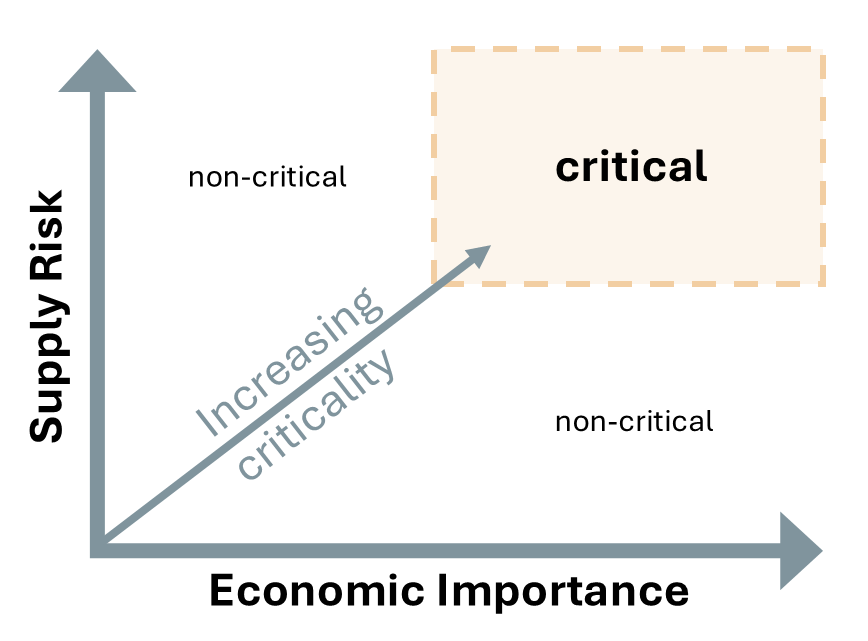
How essential is a material for key technologies or strategic sectors?
For a comprehensive assessment of 10 international CSRM strategies see IRTC (2025), Global Assessments and Strategies for Critical and Strategic Raw Materials: The State of Play in 2025.
The Role of Circular Economy
Circularity is not only an environmental but also a resilience strategy, reducing exposure to highly concentrated primary supply chains. A well-designed circular economy (CE) strategy can address both sides of the supply-demand equation for CSRMs.
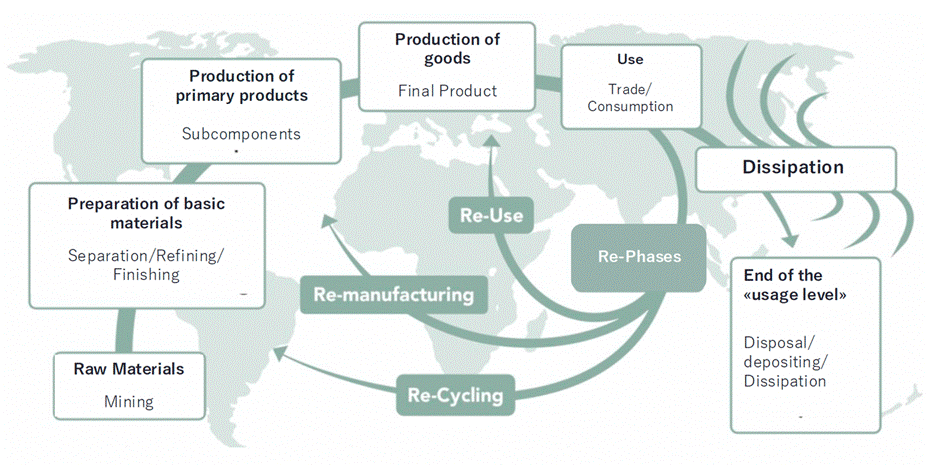
Figure 3: An illustration of the lifetime of a raw material, ending either in disposal/dissipation or in one of the “re-phases”, keeping the raw material in the economic system [Source: ForCYCLE].
Increasing Supply Through Secondary Sources
Secondary sourcing – the recovery of materials from end-of-life products, industrial residues, or manufacturing scrap – can significantly increase available CSRM supply. Metals such as copper, aluminium, nickel, cobalt, platinum-group metals, and rare earths can be recovered with high retention of quality. As more products reach their end of life (especially batteries, electronics, permanent magnets, and renewable-energy components), the volume of secondary materials will grow steadily. Today, secondary sources cannot yet meet rising demand, mainly due to long product lifetimes and the slow turnover of technologies like vehicles or power infrastructure. However, they will become an increasingly important part of global supply from the 2030s onward.
Reducing Demand Through Circular Loops
Beyond recycling, other circular economy strategies directly reduce primary material demand:

Material Efficiency
Designing products to use fewer or less critical materials (e.g., smaller EVs vs. SUVs; reduced rare-earth intensity in motors).

Reuse & Repurposing
Extending product lifetimes or giving components a “second life” (e.g., repurposing EV batteries for stationary storage).

Repair & Refurbishment
Keeping products in circulation longer and delaying the need for new material input (e.g., through repairability or design for longevity)

Remanufacturing
Rebuilding products using existing components (e.g., engines, transmissions, and starters in automotive manufacturing)

New Business Models
Product sharing or product-as-a-service, which reduces the total number of units needed (e.g., shared washing machines or tool subscriptions)
Together, these approaches can lower pressure on primary resources, reduce emissions and waste, and improve resilience against supply disruptions.
CSRMs and Defence: A Growing Connection
Defence as an Emerging Major Consumer
In the last years – especially since the beginning of the Russian war in Ukraine – defence has rapidly evolved from a minor demand sector for CSRMs to a driving force of demand and attention. The 2024 NATO assessment of defense-critical raw materials illustrates this trend:
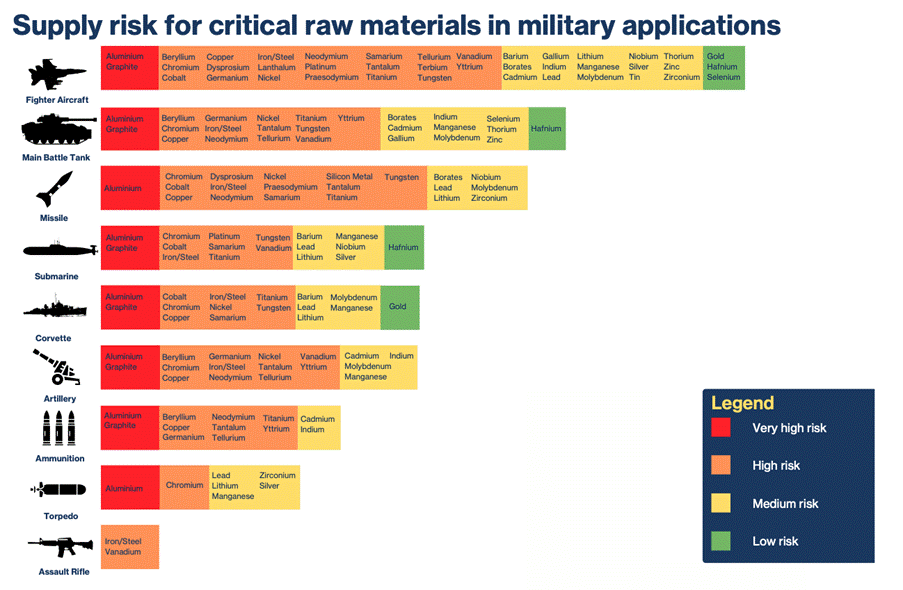
Figure 6: CSRM supply risk for military applications according to NATO (2024). Note: The analysis focuses exclusively on weapon systems and excludes digital tools, enabling technologies, and other non-weapon domains.
High Material Destruction in Conflicts
Modern weapons rely on materials such as graphite, tungsten, antimony, tantalum, silver, and rare earths. In conflict, these materials are dissipated and become effectively unavailable: once used in missiles, drones, or ammunition, they cannot be fed back into the supply chain.
Implications for Civilian Supply Chains
Military and civilian technologies increasingly draw on the same critical materials, not only for weapons, but also for battery chemistries, digital tools, and data infrastructures, all sourced from a small number of global suppliers. Such “dual use” of materials increases pressure on already constrained supply chains and complicates long-term planning for industrial transformation, decarbonization efforts, the deployment of civilian technologies, and defence readiness. The result is a tighter coupling between security policy and the material foundations of the clean-energy and digital transitions.